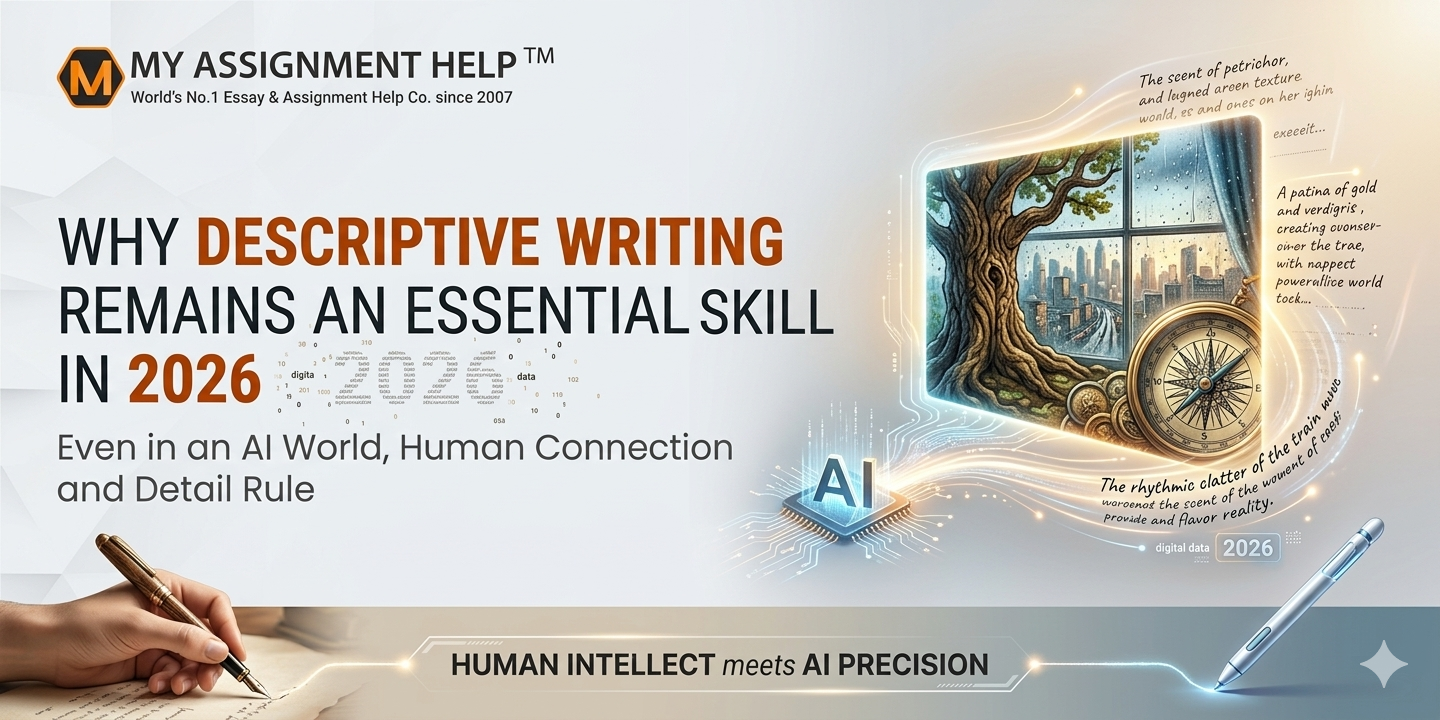
Why Descriptive Writing Remains an Essential Skill in 2026: The Human Edge in an AI Era
In 2026, the digital landscape is saturated. We are living in an era where generative AI can produce thousands of words in seconds. However, as the volume of content increases, the value of quality has skyrocketed. A significant shift has occurred: while AI handles the “surface-level” grammar and structure, it often fails at the “higher-order” abilities—specifically coherence, deep critical thinking, and visceral, sensory-driven description. Recent studies in 2026 indicate that demand for generic, templated freelance writing has declined by nearly 27%, but there is a massive resurgence in demand for writing that carries hallmarks of true human expertise and originality (Medium, 2026).
This is where the power of the descriptive narrative comes in. Descriptive writing isn’t just about “flowery” language; it is the fundamental bridge between a raw fact and a reader’s emotional response. In a world where search engines and readers alike reward Experience, Expertise, Authoritativeness, and Trustworthiness (E-E-A-T), being able to paint a picture with words is no longer a luxury—it is a competitive necessity.
The Cognitive Connection: How We Process Descriptions
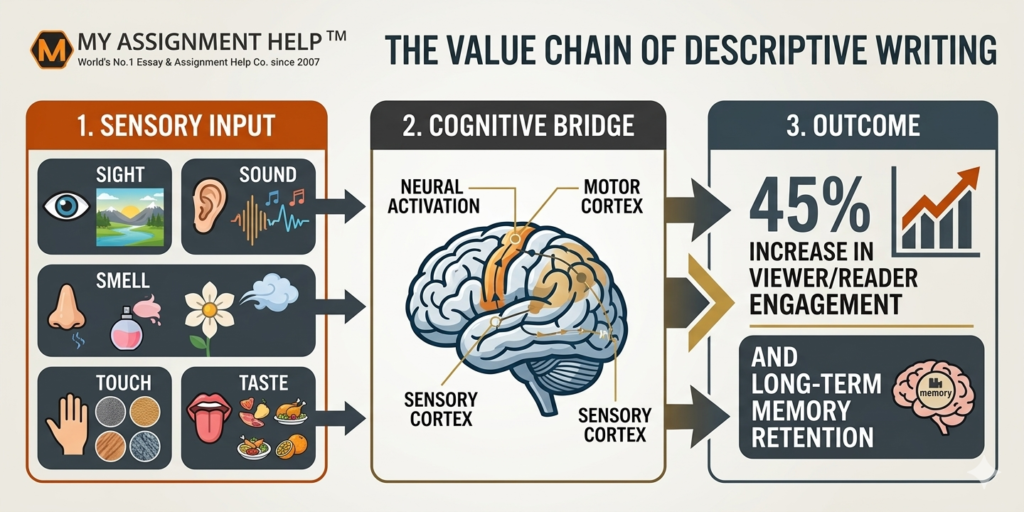
Neuroscience has shown that when we read descriptive writing, our brains don’t just process language; they simulate the experience. Research published in 2025 highlights that descriptive, sensory-rich content activates a broader neural network, including the hippocampus and parietal cortices—areas responsible for memory consolidation and spatial awareness (EMJ, 2025).
For students and professionals struggling to meet these high standards, using a professional descriptive essay writing service has become a strategic way to learn how to bridge the gap between technical data and human connection. By observing how experts use “showing, not telling” techniques, writers can develop the cognitive pathways necessary to engage modern audiences who are increasingly desensitized to generic digital noise.
5 Reasons Why Descriptive Writing is Dominating 2026
- Combating “AI Fatigue”: Readers in 2026 can spot machine-generated text easily. It’s often repetitive and lacks “texture.” Descriptive writing provides the unique, sensory details that prove a human was behind the keyboard.
- Boosting Conversion Rates: In the US digital market, “visual” copywriting—writing that helps a customer see themselves using a product—leads to a 23% higher chance of content being shared (Mac, 2026).
- Enhancing UX (User Experience): Modern UX writers use descriptive microcopy to reduce “cognitive load.” Instead of vague instructions, descriptive language guides the user empathetically through digital journeys.
- Academic Integrity & E-E-A-T: Universities now prioritize “original voice.” A descriptive essay that draws on personal observation is much harder for AI to replicate accurately than a standard argumentative piece.
- Memory Retention: As noted in 2026 educational trends, students who master descriptive techniques perform better in recall tests because they learn to associate facts with vivid mental imagery.
The Practical Reality of Modern Academic Loads
While the importance of these skills is clear, the reality for most students in the US and UK is a crushing workload. With the integration of AI into every classroom, the bar for “originality” has been raised to an almost unreachable height for a full-time student. Many find themselves searching for ways to pay someone to do assignment tasks simply to keep their heads above water.
It is not just about “outsourcing”; it is about time management. When a student chooses to delegate technical homework, they free up the mental bandwidth required to focus on mastering high-value skills like descriptive storytelling and creative synthesis—the very skills that the 2026 labor market actually rewards.
Key Takeaways
- Humanity is the Premium: As AI becomes a utility, human-centric, sensory-driven writing becomes a luxury and a mark of quality.
- Data Supports Description: Websites using clear, descriptive headlines and storytelling see up to a 25% higher conversion lift.
- Educational Shift: 2026 academic standards focus on “higher-order” skills like coherence and emotional resonance over simple factual recall.
- Strategic Support: Using professional writing services is increasingly viewed as a “hybrid” learning model, where students use expert drafts as benchmarks for their own skill development.
FAQ Section
Q1: Can AI write a good descriptive essay in 2026?
While AI can list sensory details, it often struggles with “coherence” and genuine emotional nuance. It tends to hallucinate specific sensory experiences it hasn’t “felt,” leading to content that feels hollow to a human reader.
Q2: Is descriptive writing only for creative writers?
No. In 2026, it is essential for UX designers, technical writers, and marketers. Being able to describe a user’s pain point or a product’s benefit vividly is a core business skill.
Q3: How do I improve my descriptive skills?
Start by practicing “micro-descriptions.” Describe a single object using only three senses. Over time, this builds the neural pathways mentioned in recent cognitive research.
Q4: Why is E-E-A-T important for a blog?
Google’s algorithms in 2026 are highly tuned to detect Expertise and Experience. Descriptive writing naturally incorporates “first-hand” sensory evidence, which is a major signal for E-E-A-T.
Author Bio: Sarah Jenkins
Senior Content Strategist at MyAssignmentHelp
Sarah Jenkins is a veteran educator and digital marketing expert with over 12 years of experience in the US academic sector. Specializing in E-E-A-T compliant content, Sarah focuses on helping students bridge the gap between technical proficiency and creative expression. Her research into the “Skill-to-Salary Bridge” has helped thousands of students understand which writing skills will remain future-proof in the age of automation.
References:
- Bell, R. (2026). AI Writing 2026: The Data Academia Ignores. Medium.
- Marano, G. et al. (2025). Neural Activation and Descriptive Synthesis. Catholic University of the Sacred Heart / EMJ.
- Mac, J. (2026). 116 Copywriting Statistics for the 2026 Landscape.
- Faith_Elliora (2026). Writing Trends 2026: Success through Understanding. Medium.